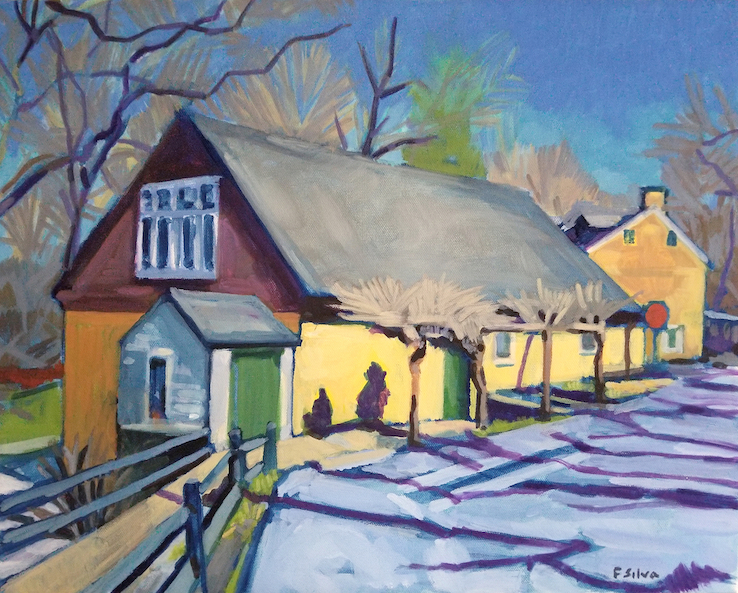
Click here to read about how my painting “Winter Shadows” was chosen as the signature image for the Phillips’ Mill 92nd Annual Art Show.
Practical information for the artist

Click here to read about how my painting “Winter Shadows” was chosen as the signature image for the Phillips’ Mill 92nd Annual Art Show.
A video of the 2021 Artsbridge Member Exhibition. All the artworks are shown and the winning artworks are awarded. My painting “Snowy Dawn” won in the category of best oil painting.
When: Febuary 6 – March 21, 2021
Where: ART150 Gallery, Jersey City, NJ
This is a video by News 12 reporting on “The Empowering: A Social Justice Exhibition” organized by Pro Arts Jersey City. My oil painting titled “The Immigrants” is highlighted in the video. Kudos to artist Danielle Scott for curating this moving and thought-provoking exhibition.
When: January 15 – February 19, 2021
Where: Studio Montclair, Montclair, NJ
A curatorial talk by artist Theda Sandiford who curated this exhibition. The video walks us through the exhibition and then Theda talks about several artworks including my painting “The Lack of Privilege“. I was lucky enough to have my painting sold at the exhibition.

Scumbling is an oil painting technique used by many painter’s throughout history. To achieve this technique, you apply a thin or transparent layer of paint over a dried layer of paint resulting in a visual, color combination of both layers.
As artists, we’re always running into roadblocks during the painting process. Scumbling can be used as a potential solution during these times. You can use it to add depth by adding contrasting color layers if your painting is too monotone. Conversely, you can reduce contrast in an area with this technique.

Throughout the history of art, many painters have used this technique. In the detail above, I show how J.M.W. Turner used this technique. You can see the layers of different colors which add texture and depth to the painting. Additionally, the darker areas of this detail are achieved with scumbling. This is a common technique used by Turner.

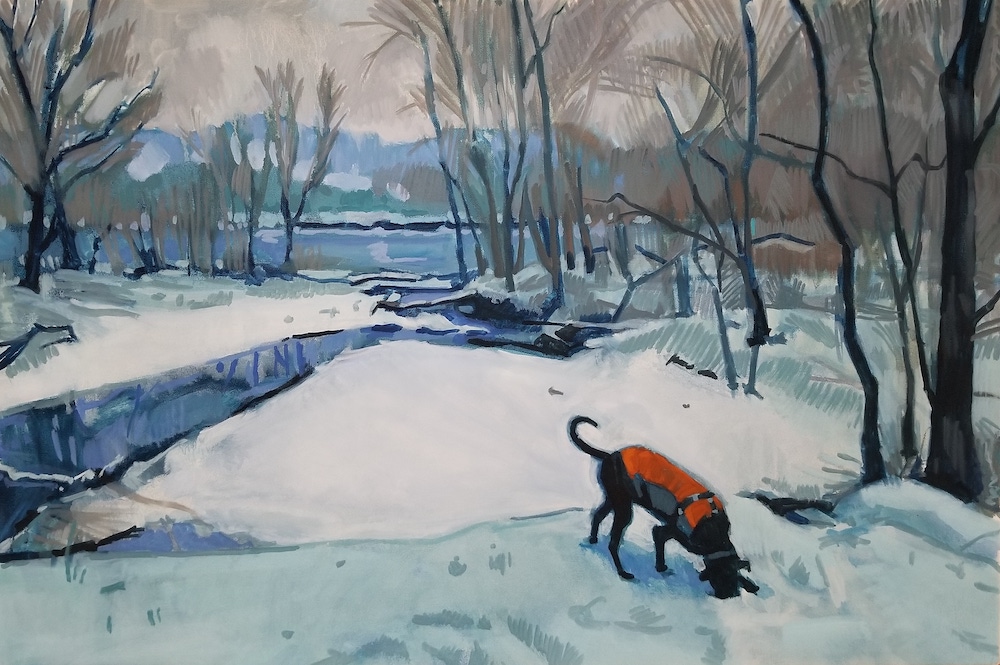
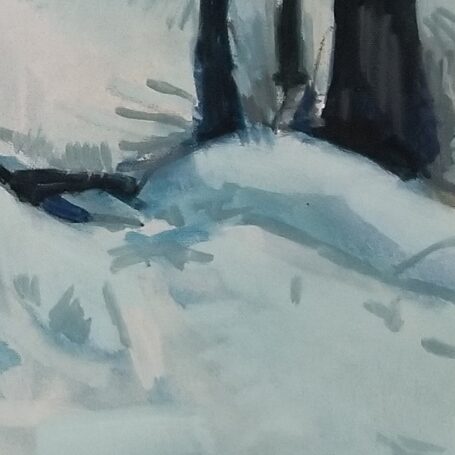
One of the challenges with this painting was to represent “snow” without using one flat “white” layer of paint. I achieved this by beginning with a light blue-green base layer. To this layer, I added a light blue layer that was lighter than the previous layer. In the third layer, I added a white (toned-down with gray) layer leaving me the option of using pure white very sparingly.
Do you scumble? How have you used it in the past? Please leave examples in the comments.

One of my paintings is currently on view at the Studio Montclair art gallery. Additionally, an online exhibit compliments the physical show. This group show titled “Privilege, Power and Everyday Life” showcases 32 artists and their interpretation of the theme. Click here for a detailed view of my painting. Click here to view the entire exhibit.
Titled “The Lack of Privilege”, my new oil painting deals with an unexpected consequence of the pandemic: I depict a food line in Queens in a latino neighborhood. COVID-19 has been devastating to poor communities specifically black and brown neighborhoods. In the painting, I show figures standing in the cold, not interacting, and waiting for their turn. The faces are unclear, smudged or, in some cases, hidden in shadows. Some figures are hidden behind others or visually blend into each other. I painted them this way to emphasize that their identities are forgotten or overlooked. Although this is a tough time for everyone, some people are deprived of essentials such as food.
In this painting I began experimenting in several ways. I normally take snapshots and use them as reference. In this case, I’ve searched online for videos taken by news outlets, I then took screenshots of the video and have used that as a foundation for this painting. I wanted to begin with a realistic, almost clinical view of the subject.
With regards to painting process, I outlined the figures in heavy black lines. The people in the food line are painted in mostly cool grays which visually separates the blue-gray sidewalk and the orange/terra cotta buildings serving to balance the composition. The brushstrokes are loose and expressionistic adding to the mood of the artwork.
The show is currently on view through February. Click here to register for a Zoom curatorial talk on January 21 at 7pm.
What do you think about the exhibition? Please share your thoughts in the comments.

The spread of COVID-19 has forced the art market to increase their presence on the virtual space. The art world now relies on their online galleries to showcase artist’s work. For the artist, this means that in-person shows have halted but virtual opportunities have been created.
The world’s behavior has changed during the pandemic. Zoom meetings, art openings, and artist’s talks have become commonplace. By actively engaging in these events you can reap short-term benefits and create a foundation for future opportunities. Additionally, I believe that these virtual events will continue to exist in the post-pandemic art market.
Have you done any of the above? How much have you participated in virtual events? Please let me know in the comments.

Juried shows are a source of frustration among artists. You enter a competition only to be rejected without ever knowing the reason why you weren’t accepted. The worst part is you’re out the non-refundable entry fee. The first juried art show I entered was held at a well-funded organization with a very nice exhibition space. It cost me $45 to join the organization and another $40 to enter the show. This seemed like a high price but I figured it would be worth it to see my paintings in that gallery space. My work was NOT accepted and I was out a total of $85. I quickly realized that this approach was financially prohibitive.
Based on this experience, I changed my strategy and began entering only juried shows that are FREE. I’m willing to make an exception and pay a membership fee to join an arts organization that offers benefits aside from the juried show. For example, I joined an arts group that has painting and social events where I can network with other artists. The juried show is an additional benefit.
A juried show can have many benefits (see “How entering juried shows helps your art career” below) but the main reason to enter is the opportunity to exhibit your work.
You can try these two websites. They both list national exhibitions but can be filtered to include territories that are near you.
https://artshow.com/juriedshows/
https://www.entrythingy.com/forartists_calls
These websites are helpful but I’ve rarely found free juried shows that were appropriate to my work. I’ve had more success by researching local art groups that host juried shows.
When you find an exhibition that works for you be aware that there’s usually a theme and the hosting organization requires submitting the following:
The above is important and time-consuming. Your images should have a professional look and follow the file naming conventions stated in the exhibition prospectus. Your bio should be well thought out and follow the industry standard. Additionally, your artist statement should be well-written and concise. If your CV looks anemic, I suggest skipping that exhibit until you gain more exhibition experience.
Do your research! Look online for previous years juried shows. Evaluate the artwork that was accepted. Does your work fit in with the others that were accepted? If you’re an abstract painter and previously accepted works were all photorealistic, this may not be the venue for you. But if it’s free, take a chance!
What are your experiences with juried shows? Please share them in the comments.

My plein air experiences began with lugging around a heavy, large French easel that tenuously held only one painting on the easel stand. After doing this a couple of times, I decided that I needed a dedicated wet painting carrier that held multiple panels and was lightweight.
I’d like to mention that I’m not getting paid for this recommendation although I wouldn’t be against that. I just think this is a very good, useful product and it could be a good addition to your plein air equipment.
Every company that produces a pochade box most likely makes a wet painting carrier. Sometimes, the panel carrier is incorporated into the pochade box and sometimes it’s an entirely separate item. The problem with both of these options is that they’re heavy. In comes the Raymar wet painting panel carrier. It has 3 slots that can hold six 1/8” painting panels back-to-back (although I only use it for three panels). It’s made of fluted plastic making it lightweight and waterproof.
NOTE: this product holds painting panels not canvases.
As a backpacker, I’m very conscious of how much things weigh and what a drag it is to carry unnecessary weight. This product’s light weight was a big selling point for me. The price depends on the size. I went with the 8” x 10” although they have different size carriers and multi-width carriers. My 8” x 10” set me back $35 (including tax and shipping). This seems a bit pricey for plastic but it’s worth the cost (and convenience) as it’s a very sturdy item.

Above is the Raymar wet painting carrier in action. See the two canvas panels in one slot? It has a velcro closing lid and adjustable strap for easy transport
What do you use to carry your wet paintings when painting plein air?

One of my paintings is currently on view in an online exhibit at Hoboken Arts. The group show titled “Transformative, Picturing Life after the Pandemic” showcases 40 artists and their interpretation of the theme. Each detail of the artwork includes the artist’s description of the piece and its relationship to the theme. Kudos to Hoboken Arts for using this format as the viewer is able to understand the thought process of the artist and what they’re experiencing during this time. Click here for a detailed view of my painting and description. Click here to view the entire exhibit.
My oil painting titled “Forever” was painted in the early stages of the pandemic. Coincidentally, I had started a series of paintings with the theme of “Isolation” and “Self-Isolation”. This painting deals with isolation in a social setting. I wanted to convey detachment and separation; the figures are together but not interacting with one another. The bar creates a physical separation between two worlds: the world of the patrons and the world of the bar area (or presumably, bartender). The patrons being unaware of what goes on behind the bar.
I wanted to create an apathetic mood by using cold blues. I used varying hues and tones of blues and emphasized loose brushwork. The only yellows exist in the figures helping them to stand out against the cool blues of the rest of the scene. To draw the viewer’s attention even further, I added dabs of oranges only on the faces and hands helping to make the figures more relatable.
The show is on view through May 31, 2020
What do you think about the exhibition? Please share your thoughts.